
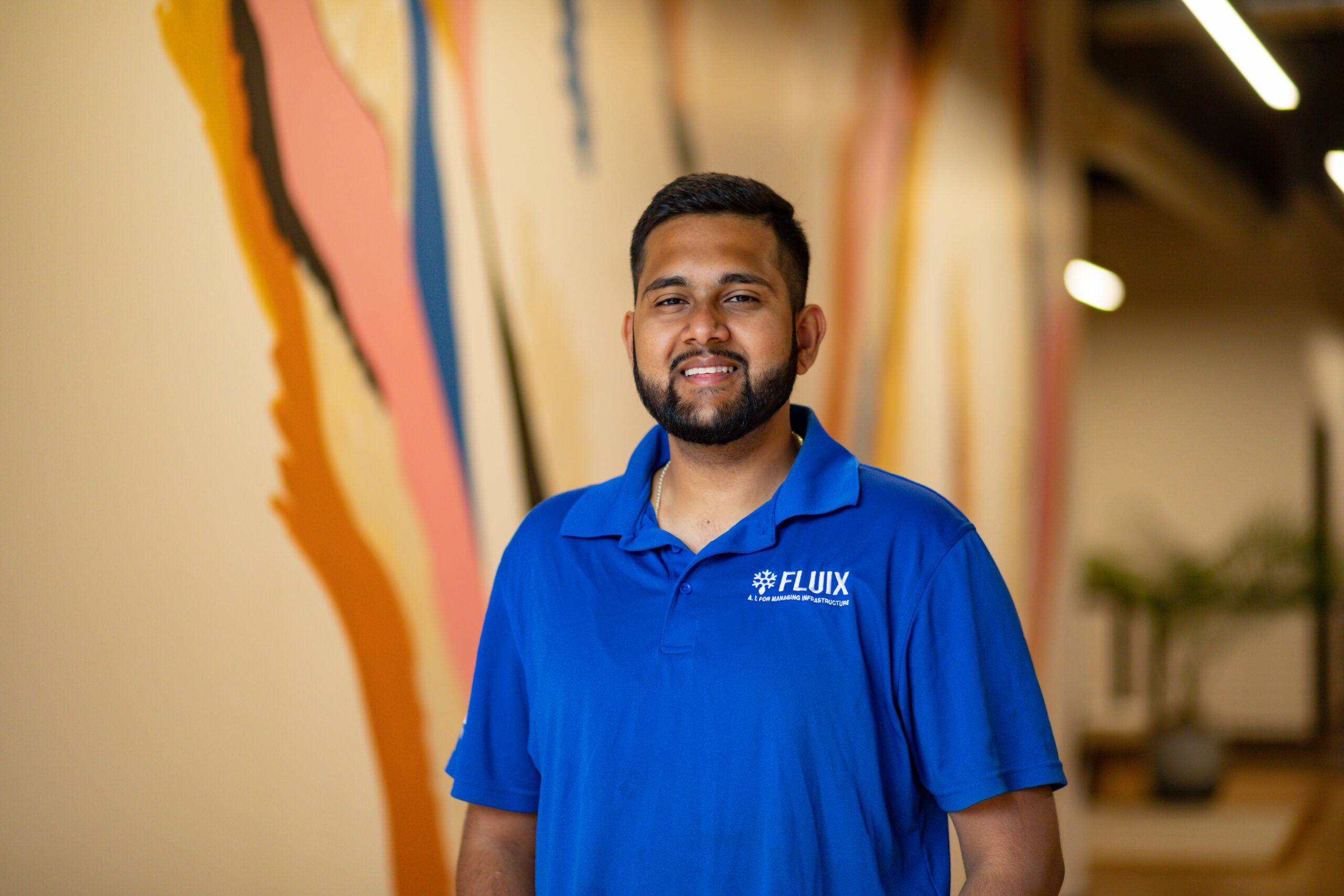
Last spring, Abhi Sastri traveled to Chattanooga from San Francisco, where his start-up FLUIX was headquartered. He’d been named one of five global startups in the 2024 CO.LAB and gener8tor Sustainable Mobility Accelerator.
Selected among 145 applicants spanning the globe, FLUIX received a $20,000 initial investment and access to 12 weeks of CO.LAB’s networking and mentoring influence.

It was a remarkably effective boost. Since then, Sastri and FLUIX have welcomed multiple investors while confronting one of our world’s largest problems:
AI and energy use.
“FLUIX AI just raised $2.1 million to tackle the growing data center energy consumption problem, using our AI Autopilot to make data centers run more efficiently,” Sastri said.
Data centers consume “10 to 50 times” the energy of a similarly sized office building, according to U.S. Department of Energy, and data centers are responsible for 2% of all carbon emissions worldwide, even more than the airline industry.
“We’ve helped our pilot customers reduce energy use by 65%, and now we’re rolling out with colocation groups across LATAM, Florida, and Utah. Backed by Shadow Ventures, Pi Labs, and Morgan Stanley Inclusive Ventures Lab, we’re scaling fast,” Sastri said.
Earlier this year, FLUIX opened its new data center lab in Santa Clara, California.
“We can showcase our AI Autopilot in action to data center customers and investors in Silicon Valley,” he said.
By 2040? Data centers are expected to consume 20% of the world’s power, Sastri said.
“For every 20 to 50 questions you ask AI chatbots like GPT, data centers can consume almost a water-bottle amount of freshwater in their evaporative cooling systems,” Sastri said last year.
Enter FLUIX.
“As large language models (LLMs) continue to drive increasing energy demands in data centers, FLUIX’s AI Autopilot platform, A.I.M.I. ®, makes these facilities ultra-efficient, reducing costs and environmental impact. Think of FLUIX as the ‘Eco-AI’ transforming data centers into fully optimized and automated AI factories,” Sastri said.
CO.LAB’s Sustainable Mobility Accelerator is designed to bridge the gaps between ideas and effective funding, creating a community of start-up professionals – civic, business and foundational – that uplift entrepreneurs dedicated to solving 21st-century problems.
“This cohort is not only the first of its kind in Chattanooga, but in the country as well,” declared CO.LAB CEO Tasia Malakasis last year. “Bringing in such a wide range of mobility startups, all that play to the strengths of Chattanooga, position this city to be a leading network for sustainable transportation, data, energy and movement.”